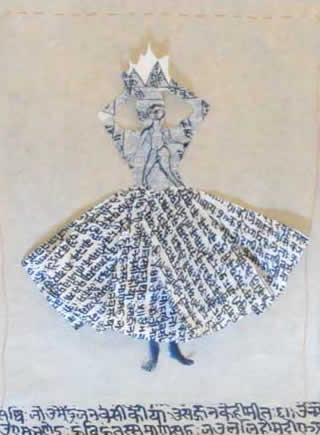
Wednesday, August 1, 2007

The Dress


I need a dress. Went dress shopping. Tried on many dresses. Stella, Prada, Oscar, Miu Miu. To see what I could see. Looked out the window of the dressing room over the avenue to the bottom of the deep blue sea. None of the dresses were the dress. I don't own any dresses. Well, a shift. Otherwise it's skirts and pants. Shoes I like more than dresses. But I must have a dress for a dress occasion. Not a suit. No pants. There are many other places to shop and I will visit some of those stores. It seemed important to begin my quest with the good stuff. Learn from the best, that kind of thing. Begin with Stevens. Bishop. Not that I can afford to actually acquire Stella or Oscar. Anyway, I prefer the dresses made by Lesley Dill, pictured here. To attend an event wearing a dress titled Woman with Hindu Healing Dress or Dress of War and Sorrow or Poem Dress of Circulation or Large Poem Dress or Unknown Nourishment. Some dress like that. Dress of paper and tea-stained vellum. Dress with Dickinson's words a single screw of flesh is all that pins the soul sewn into the waist. To wear it with great shoes.

Tuesday, July 24, 2007

On silence

The house is quiet now. It's late, every one's sleeping and I'm thinking about silence. Outside it's not so quiet because night noises abound. I live in the woods and tonight it's the whine of crickets. Soon the cicadas will sing. Other evenings coyotes call across the fields to what I don't know. The three-quarters moon is hollering right now. Is there such a thing as silence any way? Even in my head I can't find quiet. Not in the world. Sometimes I can't stand words. I get tired of them. Of talk, discussion, of trying to make sense with sentences or fragments of sentences. Which seems odd for someone who loves words. Who wants to make pictures with words and who wants to also undo herself with words. Maybe my annoyance is the result of 5 days of non-stop talking during an extended family reunion. Which was wonderful, incredible. Catching up with folks I haven't seen in years. A good thing. Seeing my sister who lives far away and dissecting again our own little family conundrums. But my brain is overtaxed with talk. It feels stuffed, as if I've eaten too much.
And so I fell into a kind of silence as I went back to work and the daily activities. Avoided people. Scrubbed the kitchen table with bleach tonight. And landed here. And re-read something I wrote not long ago when asked about silence in my poetry. And my response included the idea of reticence, conflating the two concepts, and noting some of my mentors in this enterprise-- Stevens, Dickinson, Bishop. Do silence and reticence go together? And how does a poet make use of silence in her work? Does that happen through reticence? Through white space and deletion? How important, on the other hand is telling, is story-making? My unanswered question. Silence and word work are two endeavors that compel me, even as they bounce against each other in my head.
Here's how Bishop looks at silence.

The Moose
By Elizabeth Bishop
For Grace Bulmer Bowers

From narrow provinces
of fish and bread and tea,
home of the long tides
where the bay leaves the sea
twice a day and takes
the herrings long rides,

where if the river
enters or retreats
in a wall of brown foam
depends on if it meets
the bay coming in,
the bay not at home;

where, silted red,
sometimes the sun sets
facing a red sea,
and others, veins the flats'
lavender, rich mud
in burning rivulets;

on red, gravelly roads,
down rows of sugar maples,
past clapboard farmhouses
and neat, clapboard churches,
bleached, ridged as clamshells,
past twin silver birches,

through late afternoon
a bus journeys west,
the windshield flashing pink,
pink glancing off of metal,
brushing the dented flank
of blue, beat-up enamel;

down hollows, up rises,
and waits, patient, while
a lone traveller gives
kisses and embraces
to seven relatives
and a collie supervises.

Goodbye to the elms,
to the farm, to the dog.
The bus starts. The light
grows richer; the fog,
shifting, salty, thin,
comes closing in.

Its cold, round crystals
form and slide and settle
in the white hens' feathers,
in gray glazed cabbages,
on the cabbage roses
and lupins like apostles;

the sweet peas cling
to their wet white string
on the whitewashed fences;
bumblebees creep
inside the foxgloves,
and evening commences.

One stop at Bass River.
Then the Economies
Lower, Middle, Upper;
Five Islands, Five Houses,
where a woman shakes a tablecloth
out after supper.

A pale flickering. Gone.
The Tantramar marshes
and the smell of salt hay.
An iron bridge trembles
and a loose plank rattles
but doesn't give way.

On the left, a red light
swims through the dark:
a ship's port lantern.
Two rubber boots show,
illuminated, solemn.
A dog gives one bark.

A woman climbs in
with two market bags,
brisk, freckled, elderly.
"A grand night. Yes, sir,
all the way to Boston."
She regards us amicably.

Moonlight as we enter
the New Brunswick woods,
hairy, scratchy, splintery;
moonlight and mist
caught in them like lamb's wool
on bushes in a pasture.

The passengers lie back.
Snores. Some long sighs.
A dreamy divagation
begins in the night,
a gentle, auditory,
slow hallucination. . . .

In the creakings and noises,
an old conversation
--not concerning us,
but recognizable, somewhere,
back in the bus:
Grandparents' voices

uninterruptedly
talking, in Eternity:
names being mentioned,
things cleared up finally;
what he said, what she said,
who got pensioned;

deaths, deaths and sicknesses;
the year he remarried;
the year (something) happened.
She died in childbirth.
That was the son lost
when the schooner foundered.

He took to drink. Yes.
She went to the bad.
When Amos began to pray
even in the store and
finally the family had
to put him away.

"Yes . . ." that peculiar
affirmative. "Yes . . ."
A sharp, indrawn breath,
half groan, half acceptance,
that means "Life's like that.
We know it (also death)."

Talking the way they talked
in the old featherbed,
peacefully, on and on,
dim lamplight in the hall,
down in the kitchen, the dog
tucked in her shawl.

Now, it's all right now
even to fall asleep
just as on all those nights.
--Suddenly the bus driver
stops with a jolt,
turns off his lights.

A moose has come out of
the impenetrable wood
and stands there, looms, rather,
in the middle of the road.
It approaches; it sniffs at
the bus's hot hood.

Towering, antlerless,
high as a church,
homely as a house
(or, safe as houses).
A man's voice assures us
"Perfectly harmless. . . ."

Some of the passengers
exclaim in whispers,
childishly, softly,
"Sure are big creatures."
"It's awful plain."
"Look! It's a she!"

Taking her time,
she looks the bus over,
grand, otherworldly.
Why, why do we feel
(we all feel) this sweet
sensation of joy?

"Curious creatures,"
says our quiet driver,
rolling his r's.
"Look at that, would you."
Then he shifts gears.
For a moment longer,

by craning backward,
the moose can be seen
on the moonlit macadam;
then there's a dim
smell of moose, an acrid
smell of gasoline.

Friday, July 20, 2007

On being the snail

Libra Horoscope for week of July 19, 2007

Buddhist teacher Thich Nhat Hanh, born under the sign of Libra, has been described
by a fellow teacher as “a cross between a cloud, a snail, and a piece of heavy machinery—a true religious presence.” He translates his lofty visions into the most intimate and practical terms, even providing suggestions about how to get more spiritual inspiration out of breathing, eating and walking. Take a similar approach in the coming weeks, Libra. Bring heaven all the way down to earth. Make the smallest details of your life reflect your highest ideals.

Tuesday, July 17, 2007

summertime and the living

Night

The night is July, the aura is rain.
The bay is always at low tide.
Green slime covers the sand
Where herons stop, look and listen.
The sand is as thin as clay.

Men in the night
Leave their caravans and run
Across black grass
To the River Argideen
To claim a position for fishing
Like waiting at baggage claim.

The people in the temperance hall
Hold a dance that most of them watch
From their chairs bitterly.
They can see their shoes are history.

The world was remade before they died.

The herons on the Lee
Are slick with slime, fermenting.
Lots of money is exchanged
In the medieval town.
Beer is fomented in silver silos
And no fish swim. One day down
Carpe diem.
No one knows what's coming.

The nuclear weapons programs continue.
A boy in a trap drawn by an elegant horse
Trots through Clonakilty.
Men watch and women shop.
Organic food planted in the middle
Of gourmet olives and jellies.
Thanks and help
Are prayer words in fair trade and churches.

Just go in and have a drink at dark.
It's a kind of Sabbath.
In a public house you feel safe with the others.

By now you know the black river has fish
And flowers on it white and shaped
Like strawberry plants.
Two neon kingfishers speed by blue.

Everyone is there for everyone else's fun.
Those men in the night aren't so bad.

A body: this is what it feels
And this is what it feels like.

Sites of massacre and ashes, tin-topped rubble,
Porcelain ovens, jails, a waiting hospital.

Not when it's eternal low tide in a place outside
And birds drain the sand with their appetites.


Fanny Howe

Wednesday, July 4, 2007

No fireworks tonight

This white unswaying place

I'm sorry not to have written you sooner.
We are peculiar forms, like someone's old papers rifled quickly through
But not read before the burning.
How to speak of the icy cave-like place I lately feel,
Its white reluctance dividing me from all things I desire and see.
I think it must often be the case
That one holds within oneself a guardedness, expectant, steeply quarried,
The way mistakes grow magnified inside the mind, spiked and sharply gleaming.

How skilled, how dominant, this white unswaying place.
And I wonder how, bred from our churning, it constructs itself so strongly
Like the crush of light I sometimes at the noonhour hear.

By Laurie Sheck

Wednesday, June 27, 2007

I like short stories

A friend sent me this link.
It's Miranda July's website.

noonebelongsheremorethanyou.com

I think I will look for her book.
I liked her movie.

I want to read some short story collections this summer.
Every summer I make myself an unofficial summer reading list.
I guess that's left over from school days. I like to read big fat books in the summer, the kind that take up too much space in the already overstuffed beach bag, the kind that are good to read and read when you have a stretch of time--like at the beach. So what's on my list? A mixed bag. I'm just about finished with the first book, Elaine Scarry's "On Beauty." I'm still debating whether to dive into the second volume of Hilary Spurling's biography on Matisse. I read the first book 2 summers ago. If I decide to, then that could take a chunk of time. Also on the list is Beckett's "The Unnameable." I'm looking for wildness, strangeness. Or maybe "Molloy." I probably need to read a possible text book if I teach my grad class next year. And there are a few books of poetry, including one I'll be reviewing.
I recently heard Michael Silverblatt interview author Christine Schutt on Bookworm. Her short story collection "A Day, A Night, Another Day, Summer," sounded interesting. Perhaps I'll dip into some essays. Jeff Wall's "Selected Essays and Interviews" is on a table nearby. Summer's hardly here and now it seems gone.

Tuesday, June 26, 2007

Heat


from Waterwork

by Sarah Riggs

There are whole swabs of pigment. Colors of skin bending and blending.
Skins not separate from bodies, bodies not separate from skin, and the eyes
set free from judging, the eyes in the body, and the pigments, the pigments
nestled in, drawn from within, drawn from without. The sun, the exposure,
the wind alters our skin. We change, our skin expands contracts stretches
sags, is peeled back, cut off, pierced, heals. Skin, every human has skin,
has color. There are no colors that you don't paint, there's hair in that pigment,
and nails, teeth, corpus, the pigments swirl touch breathe speak, not the
words but the blur. They're screaming, they're exalted, joy, joy in that not
judging, in that over there, and here, closer than here, farther than there.
There are no characters in your painting.


Thursday, June 21, 2007

Summer

Spoon and Tree

What gladdens her is the spoon,
with its tiny saucer of remnants,
its slender shaft, scrubbed last—
and now the kitchen's clean.
Clean are the knives and forks
all akimbo in their drying cage
at the window. The spoon
leans alone toward light,
a backyard limb reflected
in its sunken belly, so a
liquid darkness tongues
its curves and bends
along its slender neck,
making the one tidying up blush
at this bed she's come upon—
refractive, gleaming, the old
dream of coupling
here portioned out
in such a strange
supper.

When the light is gone,
the immaculate house hushed,
she puts down her book
and returns, barefooted,
waking the wood planks
to the kitchen. The cupboard,
too, sighs, its ascending note
sliding wind-clean. And even
before shaking whole grains
into her midnight bowl,
she has reached out,
across the ticking, low-watt
world, her warm mouth
clamping itself wetly
around the cooled,
hard truth
of the spoon.


Sara London

Tuesday, June 12, 2007

Flowers and history and poetry


I noticed in the long time since my last post that some blogs have pictures of flowers-even gardens. So I'm adding these. The spring has been short here it seems. Snow in April, lots of rain, still some cool nights. Summer next week. School's out. Long days slipping by too fast.
And this poem.


Don't Write History as Poetry

Don't write history as poetry, because the weapon is
the historian. And the historian doesn't get fever
chills when he names his victims, and doesn't listen
to the guitar's rendition. And history is the dailiness
of weapons prescribed upon our bodies. "The
intelligent genius is the mighty one." And history
has no compassion that we can long for our
beginning, and no intention that we can know what's ahead
and what's behind ... and it has no rest stops
by the railroad tracks for us to bury the dead, for us to look
toward what time has done to us over there, and what
we've done to time. As if we were of it and outside it.
History is not logical or intuitive that we can break
what is left of our myth about happy times,
nor is it a myth that we can accept our dwelling at the doors
of judgment day. It is in us and outside us ... and a mad
repetition, from the catapult to the nuclear thunder.
Aimlessly we make it and it makes us ... Perhaps
history wasn't born as we desired, because
the Human Being never existed?
philosophers and artists passed through there ...
and the poets wrote down the dailiness of their purple flowers
then passed through there ... and the poor believed
in sayings about paradise and waited there...
and gods came to rescue nature from our divinity
and passed through there. And history has no
time for contemplation, history has no mirror
and no bare face. It is unreal reality
or unfanciful fancy, so don't write it.
Don't write it, don't write it as poetry!
Mahmoud Darwish
translated from the Arabic by Fady Joudah


Monday, May 21, 2007

On Connections

Tomorrow I'll sit down and talk with another poet, Jill Magi, whose new book Threads has just been published by futurepoem. Our discussion is part of an interview for a journal I help edit. She's judging a contest of student work. I'm curious to hear about her process, particularly because she has successfully in this book, it seems to me, used words and visual images. Indeed, the book is described as a "hybrid work of poetry, prose and collage." This is so compelling. I consider myself inept in the making of visual images. In other words, drawing, painting, sculpting etc., while completely appealing, are talents I do not possess. (I'm not so bad in the cutting and pasting department.) Words are the way I make pictures, which lets me play with Horace's idea that painting resembles poetry. So I have many questions for Jill and the chance especially to discuss process and how she thinks about making a narrative or not. And what role collage plays in this making or unmaking. Also, the notion of history and memory. Hers plays out on a large political landscape because of the story of her grandparents and father and their life in Estonia. And autobiography too. She has elsewhere said some interesting things about the "I," a subject close to my heart.
Perhaps an excerpt from her book would be appropriate now.


from Threads

Jill Magi

Amber return, once fluid, hardened breath-trap.

Sap turns to stone as these sounds conjure whose memories?

Air pocket scarred with debris, a dictionary. His voice on tape translates

my flat speech:

too few vowels and endings that stop, closed in by consonants.

Flash card fossils. How to count, the days, the months,

I am a student, where is the bathroom, the night is long,

over the threshold, write me a letter.